
-
Scam Alert. Members are reminded to NOT send money to buy anything. Don't buy things remote and have it shipped - go get it yourself, pay in person, and take your equipment with you. Scammers have burned people on this forum. Urgency, secrecy, excuses, selling for friend, newish members, FUD, are RED FLAGS. A video conference call is not adequate assurance. Face to face interactions are required. Please report suspicions to the forum admins. Stay Safe - anyone can get scammed.
You are using an out of date browser. It may not display this or other websites correctly.
You should upgrade or use an alternative browser.
You should upgrade or use an alternative browser.
Instrument lube ?
- Thread starter cuslog
- Start date


someidiot
Well-Known Dismemberer
Yeah, that's confusing, alright, because either you leave nothing behind (i.e. cleaner only), or leave behind a (residual) lubricant.
If it were me I'd probably go with a safe silicone spray. I stress "safe" because there are some out there whose carrier is a hydrocarbon solvent that may attack plastics (I'm looking at you, Jig-a-loo). I use either Chesterton 660 or a CRC spray (can't remember specifics, can check). But what you're generally looking for is a "food safe" silicone.
If it were me I'd probably go with a safe silicone spray. I stress "safe" because there are some out there whose carrier is a hydrocarbon solvent that may attack plastics (I'm looking at you, Jig-a-loo). I use either Chesterton 660 or a CRC spray (can't remember specifics, can check). But what you're generally looking for is a "food safe" silicone.

DPittman
Ultra Member
While I don't consider WD-40 a great lubricant I think if it is used occasionally residue wouldn't be a big concern. It does have some solvent capabilities so I think occasional reapplication would keep things moving freely.Sticky Haimer edge finder . Practical Machinist said probably needs a cleaning and "instrument lube". Warned against using anything that would leave a residual, specifically said don't use WD-40 but no positive recommendation for lube. Any suggestions ?
TIA
Elektrishun
Ultra Member
A very lighweight oil like a sewing machine oil or turntable lubricant. Clean everything before applying the new oil. A little dab will do.
someidiot
Well-Known Dismemberer
Deoxit, to my understanding (never actually bought it myself) is not a lubricant, and is specifically designed for improving the electrical conductivity of gold-to-gold contacts. I can't imagine it helping in this case, and at the price I wouldn't risk wasting it.

jgimp69
Super User
There are different variations of it. Some have lubricant in them. Deoxit D is a contact cleaner base while Deoxit F I believe is a cleaner/lubricant. They also have lithium based greases as well. Expensive yes, but so is any good specialty cleaner/lubricant. A bottle of starrett tool oil is 20 bucks, but will probably last me another 20 years for the small amount I use.
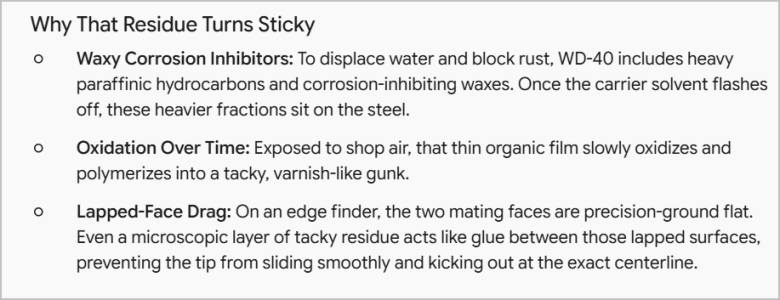
WD40 contains a high% of light solvents & therefore thin viscosity. So it might be good for the initial cleaning flushing, but not good to leave it that way. People think 'after evaporation it will leave a nice film of oil' but thats not true either. Its more of a sticky residue, not lubrication. The other aspect is application specific & this is a good example IMO. WD = water disperant which is a good thing. On a relatively open surface yes. WD40 changes the interfacial tension of any clinging moisture & flips it meaning gets between it & the metal. Now WD40 light end solvents dissolves & the exposed entrained water evaporates. Mission accomplished. Now look at this from 2 close fitting sliding surfaces with only a tiny opening edge exposed to atmosphere. The WD40 does the same thing but you no longer have the same mechanism to evaporate water from an exposed area perspective. Its essentially trapped. Escape out the tiny edge of 2 surfaces is stalled because of the tight fit & capilary forces. Result is that WD40 just temporarily holds moisture, goes flat but majority of moisture is still there on the surfaces ready to start corrosion.
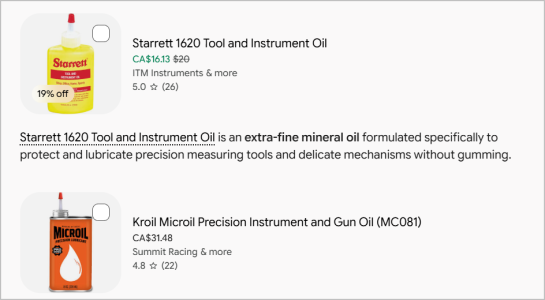
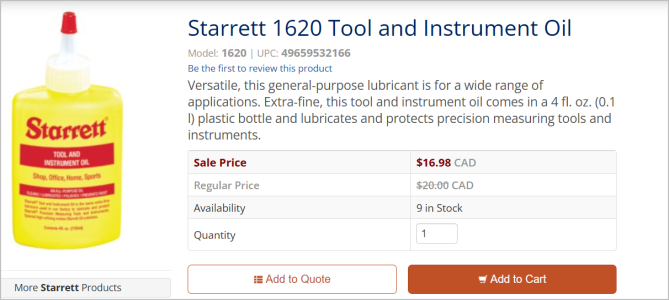
My vote for oil (if it says to oil) is Starrett or similar instriment oil which is predominantly refined mineral oil with ~2% rust & oxidation additives. Their 4oz size will last your lifetime for all instruments. Its the right viscosity. Second choice if you have it already is sewing machine oil which amost identical (usually just mineral oil). When you dig into the contents of similar oils, mostly what varies is $/ml & marketing. Of course there are all kinds of other oils out there. Teflon/PTFE have their place too but just know they are solids in a carrier. The solids never go away & can accumulate in tiny areas over time. Good for a lot of things but there probably is a limit as surfaces & fits get small. Lubrication can be a lot of black magic & marketing.
 www.kbctools.ca
 www.itm.com
My vote for oil (if it says to oil) is Starrett or similar instriment oil which is predominantly refined mineral oil with ~2% rust & oxidation additives. Their 4oz size will last your lifetime for all instruments. Its the right viscosity. Second choice if you have it already is sewing machine oil which amost identical (usually just mineral oil). When you dig into the contents of similar oils, mostly what varies is $/ml & marketing. Of course there are all kinds of other oils out there. Teflon/PTFE have their place too but just know they are solids in a carrier. The solids never go away & can accumulate in tiny areas over time. Good for a lot of things but there probably is a limit as surfaces & fits get small. Lubrication can be a lot of black magic & marketing.
STARRETT,STARRETT 1620 TOOL AND INSTRUMENT OIL,1-855-53216,KBC Tools & Machinery
STARRETT,STARRETT 1620 TOOL AND INSTRUMENT OIL,1-855-53216,KBC Tools & Machinery
Starrett 1620 Tool and Instrument Oil
Starrett 1620 Tool and Instrument Oil. Great savings and get fast delivery when you order online at ITM.com. In stock, ships same or next day.
Attachments

My untrained mind says sewing machine oil, used very sparingly. Recently I've been disassembling century-old Singer sewing machines, and not one of them has had any indication of sludge build-up or sticky residue on the operating mechanisms. When I pull them apart I can see the very thin oil film, but it doesn't seem to capture lint or dust.


Clean with a good solvent then dry - no oil of any kind.
If you really feel you must use oil, then you can get starrett instrument oil on Amazon.
If you really feel you must use oil, then you can get starrett instrument oil on Amazon.

Tom O
Ultra Member
AH, A Janice Joplin fan….I use KY on my instrument...
KY KYYYY BABY DA DA DA Ky BABY

Tom O
Ultra Member
That 3 in 1 oil has fed many a sewing machine families when it eventually gums up.My untrained mind says sewing machine oil, used very sparingly. Recently I've been disassembling century-old Singer sewing machines, and not one of them has had any indication of sludge build-up or sticky residue on the operating mechanisms. When I pull them apart I can see the very thin oil film, but it doesn't seem to capture lint or dust.