• Scam Alert. Members are reminded to NOT send money to buy anything. Don't buy things remote and have it shipped - go get it yourself, pay in person, and take your equipment with you. Scammers have burned people on this forum. Urgency, secrecy, excuses, selling for friend, newish members, FUD, are RED FLAGS. A video conference call is not adequate assurance. Face to face interactions are required. Please report suspicions to the forum admins. Stay Safe - anyone can get scammed.
  • The 2026 Calgary Area Meetup is set for Saturday May 30th at 10am. The signup thread is here! Robinhood has graciously offered to host the meetup again this year. Please note that you MUST RSVP to the notice linked above if you wish to come.

Identifying a thread

DPittman

Ultra Member
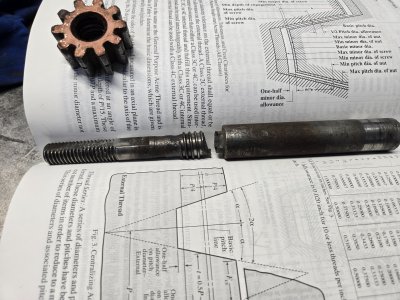
Okay I started with my Machinery's Handbook and sort of got overwhelmed.

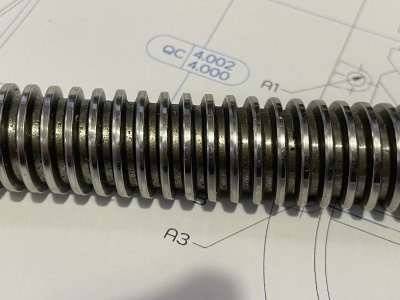
I think it is an acme thread with 8tpi.

Any hints on how to identify a thread without high end measuring tools. It seems to me there are acme, square and "unique" threads that can look very similar especially if they are worn.
Ive never cut acme threads before and this looks like a challenge that Id like to attempt.
 

Attachments

  • 20261010_110638.jpg
    20261010_110638.jpg
    1.4 MB · Views: 16
  • 20261010_110621.jpg
    20261010_110621.jpg
    1.9 MB · Views: 15
Does't look like a true ACME thread form. Trapezoidal threads have flat shoulders, and the tooth root and tip are the same width

In fact i'd almost say its a worm. What is the mating part?
IMG_7815.JPG
 
My first thought is worm too, but the adjacent shoulder sort of rules that out. So does the lack of worm wear patterns

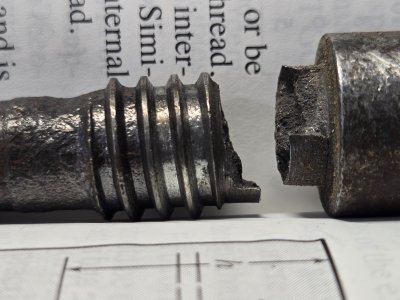
Next guess is worn acme. But the gnarly look of the metal at the thread roots says otherwise.

So I'm gunna go out on a limb and say that it's a poorly formed acme thread. The thread roots, the rest of the shaft surface, and the break all suggest that the part is cast. The basic threads were likely cast in too. If so, the surface of the threads were probably cut a bit or burnished afterward to achieve a smooth working thread surface.

Like most threads, you can follow standards to achieve compatibility or a machinist can make whatever he wants. This is a perfectly useable thread but it needs a custom matching nut because the thread profile ratios are not standard.

If you can't find an original replacement, I'd make a new one to match the nut. Forget about casting. Just make a better one out of steel.

Can, we see the rest of the machine where that fits?
 
Back
Top