• Scam Alert. Members are reminded to NOT send money to buy anything. Don't buy things remote and have it shipped - go get it yourself, pay in person, and take your equipment with you. Scammers have burned people on this forum. Urgency, secrecy, excuses, selling for friend, newish members, FUD, are RED FLAGS. A video conference call is not adequate assurance. Face to face interactions are required. Please report suspicions to the forum admins. Stay Safe - anyone can get scammed.
  • The 2026 Calgary Area Meetup is set for Saturday May 30th at 10am. The signup thread is here! Robinhood has graciously offered to host the meetup again this year. Please note that you MUST RSVP to the notice linked above if you wish to come.

How to lock lathe spindle to tighten ER40 collect chuck

kevin.decelles

Jack of all trades -- Master of none
Premium Member
Since it'll come out eventually, I snapped the pivot post on my lathe brake because I've been using that to stop the spindle when using my ER40 torque wrench. Lesson learned. It worked great, I could use my foot and then both hands on the torque wrench.

A quick google (post incident) says to engage the spindle lock (isn't one) or to insert a pin/square-wrench in the D1-5 camlock hole to hold the chuck.
this would 'work' but doesn't feel nearly as skookum as the foot-brake....... and I lose one arm to the other wrench.

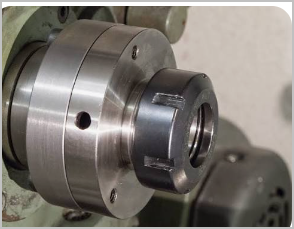
What are others doing? I use the precision mathews collet chuck, and like it. There are pin-holes on the chuck itself but I'm not keen on engaging those.
Its apples vs. oranges - but for ER32 collets on the lathe I originally made a wrench to grab the flats on my ER 32 collet in the lathe. When I went to a larger ER 32 wrench (not torque but much larger) - Ifound a wide mouthed narrow jaw for a reasonable price at Princess Auto - It can do double duty on both the lathe and mill.

My lathe might be smaller - but I can use the backsplash or ways(with a board to protect) to hold the wrench while I tighten/loosen the collet nut....

Hope you find a good solution!
 
Since it'll come out eventually, I snapped the pivot post on my lathe brake because I've been using that to stop the spindle when using my ER40 torque wrench. Lesson learned. It worked great, I could use my foot and then both hands on the torque wrench.

A quick google (post incident) says to engage the spindle lock (isn't one) or to insert a pin/square-wrench in the D1-5 camlock hole to hold the chuck.
this would 'work' but doesn't feel nearly as skookum as the foot-brake....... and I lose one arm to the other wrench.

What are others doing? I use the precision mathews collet chuck, and like it. There are pin-holes on the chuck itself but I'm not keen on engaging those.
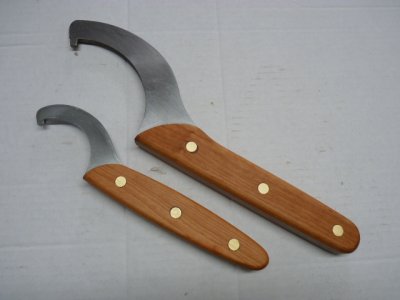
Kevin - are you holding your ER40 with the lathe chuck? Reason I ask is what if you put a bar from the chuck jaw edge down to the ways holding the chuck in place while you tighten the ER40 collet? the bar stops the chuck from turning...? is that clear?
 
In a lathe when turning you shouldn't need to tighten the collet any more than you would the 3J chuck. The cutting force is only going to to stop the work from spinning if it's not tight enough.

In a milling operation, lathe or milling machine, it's different because the spiral cutting force of the bit could cause the bit to pull itself out of the chuck then you have bit pieces going in ever direction.

I've never had either happen but I don't do .250 cuts that would require gronking things to be spec tight.
 
In a lathe when turning you shouldn't need to tighten the collet any more than you would the 3J chuck. The cutting force is only going to to stop the work from spinning if it's not tight enough.
In terms of what the part sees relative to the gripping jaws or collet faces, this is true. But the mechanical advantage profile of a chuck scroll mechanism vs a ER nose thread pitch acting on the collet taper are very different. The tightening torque value that works on a chuck may well slip on ER, so its back to the drawing board of what the manufacturers rcommend. And ER's are high. If you can get away with less torque of course that's preferable but you don't really know until it slips.

I dont think its kind to the lathe gear train to use it like a high torque level brake. Strength is limited by the width of engaged teeth. We do it all the time at reasonable levels & the same teeth are responsible for converting motor torque to spindle torque against cutting forces. But that's more running conditions vs a wrench gronk. I would machine some feature on the ER backplate or around the nose profile if there is enough room, something to get some kind of holding wrench on it. Then the torque difference is then confined to the ER fixture itself, the lathe is no longer in the picture. How about a decent size radial hole in the backplate & it accepts a round dowel ended holding wrench? Kind of like these set screw holes are orientated?

1793034247374.png
 
Ah yes but you're probably a beefy welder and I'm retired IT hack with pencil arms.
If you happen to have a torque wrench it might not hurt to do a crude test. You may not have to give it nearly as much umff as you think with a snipe that long. At 30" to get 130 ft/lbs only requires 52 pounds. Thats just a little bit of a lean on the bar for the average size person. Not trying to say you don't have a better understanding of what you are doing I'm just thinking that if it ended up that you where applying a fair bit more torque than you initially thought once dialed back maybe the foot brake would hold ok. That is one it is repaired. I can definitely see how using it would be a lot more convenient.
 
Back
Top