
-
Scam Alert. Members are reminded to NOT send money to buy anything. Don't buy things remote and have it shipped - go get it yourself, pay in person, and take your equipment with you. Scammers have burned people on this forum. Urgency, secrecy, excuses, selling for friend, newish members, FUD, are RED FLAGS. A video conference call is not adequate assurance. Face to face interactions are required. Please report suspicions to the forum admins. Stay Safe - anyone can get scammed.
-
The 2026 Calgary Area Meetup is set for Saturday May 30th at 10am. The signup thread is here! Robinhood has graciously offered to host the meetup again this year. Please note that you MUST RSVP to the notice linked above if you wish to come.
You are using an out of date browser. It may not display this or other websites correctly.
You should upgrade or use an alternative browser.
You should upgrade or use an alternative browser.
How many feet?
- Thread starter fireguyfire
- Start date
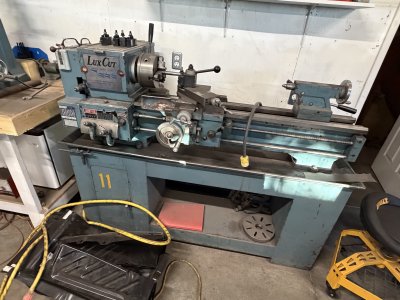

Four under the head and two or four under the tailstock. Have a good look at the bottom of the tailstock end cabinet. You can usually see how many feet it is made for. From here in Ontario, it looks like 4. But it might be two. Use as many as it is designed to take.

TorontoBuilder
Sapientia et Doctrina Stabilitas
I concur with @SusquatchI’m looking to put levelling feet on my Luxcut 1136 lathe. I’m trying to figure out how many I should use on the cabinet?
That's just an early model craftex and the head has 4 locations to add leveling feet. Use them all, use dampening material in the feet too.
I did the same on our old craftex 12x37 lathe, it worked out well

Loosenut
Member
I found that two where enough as long as you have a right and a left.
Bazinga, tip heavily I'm here all week. 🙂
Back many years purchased machine levellers with damping material where costly and probably are not any cheaper now. The simple solution was hockey pucks. They cost about $1.00 then, I don't know how much now but it was a simple project to get a short piece of pipe, the right diam., weld a plate on top with a heavy screw above that and bingo instant height adjustable machine levellers. The pucks help keep the machine from vibrating but also stops-ish lateral movement. Machines that are not bolted down have a tendency to walk around some. I built two lathe stands with four pucks each on the bottom and the tops of the stands had four on the headstock end and two on the tail stock.This was dictated by the number of mounting holes on the lathe. You can rough level the stands with the bottlom levellers and then dial the lathe in with the top screws.
Bazinga, tip heavily I'm here all week. 🙂
use dampening material in the feet too.
Back many years purchased machine levellers with damping material where costly and probably are not any cheaper now. The simple solution was hockey pucks. They cost about $1.00 then, I don't know how much now but it was a simple project to get a short piece of pipe, the right diam., weld a plate on top with a heavy screw above that and bingo instant height adjustable machine levellers. The pucks help keep the machine from vibrating but also stops-ish lateral movement. Machines that are not bolted down have a tendency to walk around some. I built two lathe stands with four pucks each on the bottom and the tops of the stands had four on the headstock end and two on the tail stock.This was dictated by the number of mounting holes on the lathe. You can rough level the stands with the bottlom levellers and then dial the lathe in with the top screws.
TorontoBuilder
Sapientia et Doctrina Stabilitas
Hockey pucks are my go to...I found that two where enough as long as you have a right and a left.
Bazinga, tip heavily I'm here all week. 🙂
The simple solution was hockey pucks. They cost about $1.00 then, I don't know how much now but it was a simple project to get a short piece of pipe, the right diam.,
I bought a bucket of used pucks off a guy years ago and still have a lot left.
I recess a metal foot to insert a cut off disc, dab of any glue and voila.

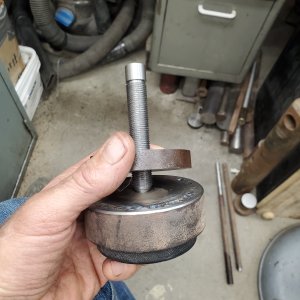
You can rough level the stands with the bottlom levellers and then dial the lathe in with the top screws.
I think its the opposite. In fact, I don't recommend or use topside adjustments at all. Just lock them down.
@fireguyfire will find that the bottom screws will be more sensitive - ie, it takes more turns of the nut to move the bubble or the needle. This dramatically improves the common complaint about chasing the bubble.
For the top side, what you want is a solid non-movable mount that is articulated by the screws at the bottom of the cabinet. Effectively, the entire right and left cabinet become huge levers that bend or twist the lathe itself. The height of these cabinets increases the physical leverage and desensitizes the adjustment.
Both cabinets on my lathe have 4 feet each. This makes it much easier to unbend and untwist my lathe bed.
One of the problems is the slab is not stationary, and if you've mucked about with this, you know it can move enough to create tapers.
On big lathes, 6, 8 10 or more feet you have no choice but to deal with it and tweak them occasionally. But on small lathe, I'd be thinking how to get it on three feet, like a Schaublin or Monarch 10ee. Monarch has three contact points under the massive cast iron stand and the stand is properly fit to the bed. Great if there is a massive CI stand scraped to the bed, but what about the style like in this thread? Schaublin mounts the bed to the tray or stand via the hemispherical washers, that fit in a matching counter sink. Two at the HD and one at the tailstock. just food for thought ..... get the lathe attached to the stand by three points, maybe via an adapter plate, and never worry about twist/levelling again
On big lathes, 6, 8 10 or more feet you have no choice but to deal with it and tweak them occasionally. But on small lathe, I'd be thinking how to get it on three feet, like a Schaublin or Monarch 10ee. Monarch has three contact points under the massive cast iron stand and the stand is properly fit to the bed. Great if there is a massive CI stand scraped to the bed, but what about the style like in this thread? Schaublin mounts the bed to the tray or stand via the hemispherical washers, that fit in a matching counter sink. Two at the HD and one at the tailstock. just food for thought ..... get the lathe attached to the stand by three points, maybe via an adapter plate, and never worry about twist/levelling again
get the lathe attached to the stand by three points, maybe via an adapter plate, and never worry about twist/levelling again
Is there an issue in this forum that gets more posts, threads, and discussion than lathe alignment????
Yup, this issue you raise is an issue that comes up every time I talk about lathe alignment. Certain lathes can't really be aligned, or like you describe they are aligned at the factory and are designed in a way that maintains that factory alignment in use. Although I don't own one like that (and wish that I did), I can certainly appreciate them for what they are. I'd also submit that most guys who do own one, already know their advantages and don't need advice from the likes of me.
But there is another category of lathes that can benefit from our advice. That category is all the little lathes as well as the Myfords and South Bends that don't typically come with stands and don't typically get aligned even if they do need it.
I am nothing if not consistent. Rather than guessing or assuming, I ALWAYS recommend evaluating that need and then deciding on what if anything can be or needs to be done. I frequently hear guys say that these lathes only have single bolt mounts that can only be shimmed. In my opinion, that's inaccurate. The lathe mounts and the cabinet can usually be joined solidly at the mount such that the mount can be articulated by feet at the bottom of a cabinet designed to provide this functionality. Nuff said.