• Scam Alert. Members are reminded to NOT send money to buy anything. Don't buy things remote and have it shipped - go get it yourself, pay in person, and take your equipment with you. Scammers have burned people on this forum. Urgency, secrecy, excuses, selling for friend, newish members, FUD, are RED FLAGS. A video conference call is not adequate assurance. Face to face interactions are required. Please report suspicions to the forum admins. Stay Safe - anyone can get scammed.
  • The 2026 Calgary Area Meetup is set for Saturday May 30th at 10am. The signup thread is here! Robinhood has graciously offered to host the meetup again this year. Please note that you MUST RSVP to the notice linked above if you wish to come.

Drone sprayer

you are thinking the wrong way if you are thinking of a large business with many employee's who all work year round, most if not all aerial application companies are small and mostly employ a few seasonal workers for ground operations. Thats the nature of it, just like any other small and seasonal business, like farming (without livestock), how many employees do you have @Susquatch ?

I wasn't thinking that way at all. I was thinking of a two man operation which is what the demo I saw implied was necessary. One man to fly, and one to prep the next refill and recharge cycle. I suppose that one man (like my own farm) could do both but then the economics of keeping that bird in the air to do as many acres as possible goes to hell in a hand basket.

This isn't at all like seasonal farming, but even if it were, I don't like the idea of seasonal labour.

Fundamentally, I am opposed to any seasonal employment where the employer exploits the short term needs of the employees. I know it happens, I just don't like it. On the family farm its all-for-one and one-for-all.

Lots of farms employ seasonal workers that come over on a visa, then go home when the seasons over

I know. And I don't like it. But that debate quickly becomes a political one so let's not go there.

The technology is new, the regulations are not there yet to allow it to be profitable in Canada (as i stated in my first post), but times changes, regulations change.

From the perspective of the user, regulations almost always change for the worst.....

Look, I think we might be looking for arguments here. All I really wanted to say is that I don't think drone spraying makes sense for me as a farmer yet. Especially not if I am the fellow buying the drone.

You have also said that, so I don't know why we are arguing.

And just to point out how much we actually agree, I'd be among those who would say that there may be a host of other applications that do make sense. From that bigger perspective companies using drones for multiple applications (including farm spraying) with employees working all year long, might be a totally viable business.
 
So,I don’t want to argue about any of it with anyone, I am more interested in what a drone can or can’t do. A drone can be used also for fast livestock counts, or location finding of livestock, spot fertilizer application, or spraying as previously noted. The biggest problem with a helicopter type drone is payload size/weight to lift ability, a big advantage is a small operation based area for take/landing.
Most of the ag drones I think are somewhat self flying, send out/return, take off/land and can follow a programmed flight path. And becoming more so. Of course this does mean the field area/size has to have the perimeters mapped/input to system. Once this is done, the same area could be/can be be covered many times doing different jobs. In the process, not damaging chops/ground cover.
It should be kept in mind that drones are also fixed wing, tracked, wheeled, floating, propelled in a number of different ways, some even have legs and are used for a multitude of things.
I guess drones will likely become of more use in time, much like 3d printing has become. Will everyone have one?——- But not everyone has a 3d printer or a car etc. either.
 
Last edited:
I am more interested in what a drone can or can’t do.

Here is what I use my current drone for:

On going post emergence field evaluation. How are my crops doing on a granular basis? Are there any soil, fertilizer or drainage issues that I need to deal with after harvest?

On going pest control evaluations. Are any bugs, diseases, or predation attacking my crops in places that I can't see from the perimeter of my farm fields?

On going crop health evaluations. Are there any slow growth or yield deficiencies out there that I can't see from the field perimeter? There are specialized applications that can identify health issues from a photo. They work pretty well.

Big rock location.

Mapping out drainage issues.

Surveying in conjunction with my RTK GPS system.

Maybe a few others I've forgotten about.
 
I wasn't thinking that way at all. I was thinking of a two man operation which is what the demo I saw implied was necessary. One man to fly, and one to prep the next refill and recharge cycle. I suppose that one man (like my own farm) could do both but then the economics of keeping that bird in the air to do as many acres as possible goes to hell in a hand basket.

This isn't at all like seasonal farming, but even if it were, I don't like the idea of seasonal labour.

Fundamentally, I am opposed to any seasonal employment where the employer exploits the short term needs of the employees. I know it happens, I just don't like it. On the family farm its all-for-one and one-for-all.


I know. And I don't like it. But that debate quickly becomes a political one so let's not go there.


From the perspective of the user, regulations almost always change for the worst.....

Look, I think we might be looking for arguments here. All I really wanted to say is that I don't think drone spraying makes sense for me as a farmer yet. Especially not if I am the fellow buying the drone.

You have also said that, so I don't know why we are arguing.

And just to point out how much we actually agree, I'd be among those who would say that there may be a host of other applications that do make sense. From that bigger perspective companies using drones for multiple applications (including farm spraying) with employees working all year long, might be a totally viable business.
I think that with how drones are evolving they will soon be 100% flying on autopilot. They already have drones that detect what a field needs and where. I would be surprised if they don't already have software that controls where the drone flies and what is applied and in what amounts based on scans. I'm certain some sort of an autofill system will be developed also.

Since I fix aircraft for a living I'm looking forward to this.
 
I think that with how drones are evolving they will soon be 100% flying on autopilot. They already have drones that detect what a field needs and where. I would be surprised if they don't already have software that controls where the drone flies and what is applied and in what amounts based on scans. I'm certain some sort of an autofill system will be developed also.

Since I fix aircraft for a living I'm looking forward to this.

Actually, that's exactly how the ones I saw work. You program in the field coordinates and the application amounts before you fly. The drone just goes and does it.

The fill system isn't really a big deal either. It can be automated.

I think what you are suggesting is that two men are not really required.

But as @phaxtris suggested, I was told it's the regulations that prevent one man operation. The regulations won't allow you to fly without eyes always on the bird, and the regulations won't allow you to automate chemical mixing. However, you can automate application rates as long as a human is there watching to identify problems.

I suppose it's possible that these regulations might be relaxed some day, but I'm not counting on it. In my experience, regulations usually get stricter and seldom become more permissive. I wish I could say otherwise.
 
A large portion of my family were farmers from childhood until very old age and some, death, i have spent many summer months on the farm, not an employee to be seen, was that not a business because it didnt provide a living for multiple employees, only the owner and their family?

I thought farmers traditionally had big families to exploit the free labour?😉


My mother is the youngest of 13 siblings. My grandparents on that side were pre-industrial farmers without heavy machinery and banging out kids was the way to have labour to work the farm.
 
I thought farmers traditionally had big families to exploit the free labour?😉

Of course they do! All-for-one and one-for-all! They also all lived on the farm all year round.
My mother is the youngest of 13 siblings. My grandparents on that side were pre-industrial farmers without heavy machinery and banging out kids was the way to have labour to work the farm.

Mine too. In fact, that's my own history.

But to be fair, they had no birth control, it was a great way to enjoy the cold winter nights, their religions encouraged lots of kids, most of the girls went to live with boys in other families, most of them absolutely loved all their children, and most would die for them if it came down to that.
 
Actually, that's exactly how the ones I saw work. You program in the field coordinates and the application amounts before you fly. The drone just goes and does it.

The fill system isn't really a big deal either. It can be automated.

I think what you are suggesting is that two men are not really required.

But as @phaxtris suggested, I was told it's the regulations that prevent one man operation. The regulations won't allow you to fly without eyes always on the bird, and the regulations won't allow you to automate chemical mixing. However, you can automate application rates as long as a human is there watching to identify problems.

I suppose it's possible that these regulations might be relaxed some day, but I'm not counting on it. In my experience, regulations usually get stricter and seldom become more permissive. I wish I could say otherwise.
Yes I am suggesting no oversight will be required. You are correct though we are not there yet for various reasons both technical and regulatory. It's coming. When I took my aviation rules exam in college one answer was banned. We were asked can you do this sort of questions. The banned answer was "yes, with permission from the minister". Point is eventually they will get permission from the minister. I suspect the drones will be heavily monitored with AI software and sensors. If anything goes wrong they will either receive an automatic land or return home and land. I'm speculating of course but I do think we have barely explored what drones will be capable of doing.
 
Sorry to say it, but there are a couple of wars going on, drones appear to be a large part of them and possibly/likely getting more so. Possibly a large part, set and turn loose.
I read a book about how military drone operators get PTSD, or get burnt out, from flying the missions. Everyone assumed it was like playing a video game but nobody really understood what it was actually doing to the human psyche.
 
Yes I am suggesting no oversight will be required. You are correct though we are not there yet for various reasons both technical and regulatory. It's coming. When I took my aviation rules exam in college one answer was banned. We were asked can you do this sort of questions. The banned answer was "yes, with permission from the minister". Point is eventually they will get permission from the minister. I suspect the drones will be heavily monitored with AI software and sensors. If anything goes wrong they will either receive an automatic land or return home and land. I'm speculating of course but I do think we have barely explored what drones will be capable of doing.

most of the regulation problems are not with the part of actually flying the drones, that is all worked out, no problems, the regulations holding things up have to do with the "aerial applicator" side of things, thats a separate license in itself. There is a whole world of regulations regarding the spraying that have nothing to do with the actual flying, that side of things wants all sorts of different testing on a whole host of things related to how it is applied (spray pattern, droplet size, rotor effects on the spray, bla bla bla).

I do believe you would require 2 people to satisfy the regulations of flying the drones and to keep the workload down, you would have a drone back every 5-10 minutes for loading and swapping batteries, 2-3 minutes to swap batteries and load, with 3-4 drones it could be a pretty heavy workload for one person to manage once you add in the onus of monitoring (and possibly not legal with 1). 3-4 drones could spray a similar amount acreage as a smaller spray plane such as an ag cat or cessna 188.

The operating costs would be less, you have no hangar, repairs would be far less, however you do have the cost of batteries, with a 10 minutes (average) flight time per cycle and batteries rated for 1500 cycles, on the low end you are getting 250 flight hours per battery, at a cost of between 2000, and 4000 per battery, 8-16$ per hour per drone, lets call it 16$, x4 drones, 64$ an hour worst case, vs 17-30gph on a small spray plane (depending on the aircraft & engine) @ 6.70-8.50 per gallon, + tires, oil, annual

@Susquatch I agree, i dont think it makes any sense for a single farmer to buy and try to spray his own fields, the investment is far to high for such low use and production, whoever was trying to sell you on that was out to lunch, that would be like trying to tell a farmer to buy an air tractor to spray his own fields. The only use case for aerial spraying is as a spraying business, difficult, small, hard to access fields, and potentially high value crops (garlic, orchards, etc etc) that is worth spraying aerially in the first place, or large parks/nature reserves
 
Question.

These batteries that take only a few minutes to swap out...

How long do they take to actually charge?

Because THAT determines what the financial state is, IMO.

If you have to have a huge diesel genset, and a large inventory of batteries to stay running on a continuous basis, you rapidly become less cheap than the commercial alternatives! More Farmer math.
 
Question.

These batteries that take only a few minutes to swap out...

How long do they take to actually charge?

Because THAT determines what the financial state is, IMO.

If you have to have a huge diesel genset, and a large inventory of batteries to stay running on a continuous basis, you rapidly become less cheap than the commercial alternatives! More Farmer math.

They say 9- 12 minutes, you need at least 6000 watts per charger

It makes 0 sense to operate 1 as a single farmer only spraying his/her own field, the investment is far to high for the return

But as a spraying operation it is considerably less costly on all fronts from initial investment to hourly operating costs compared to traditional fixed wing application
 
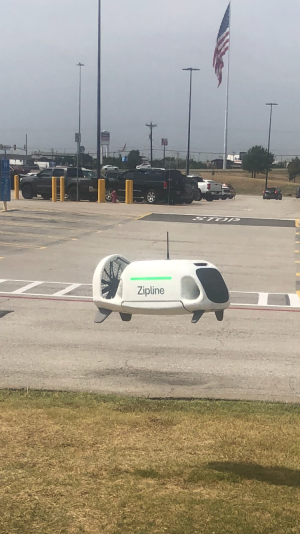
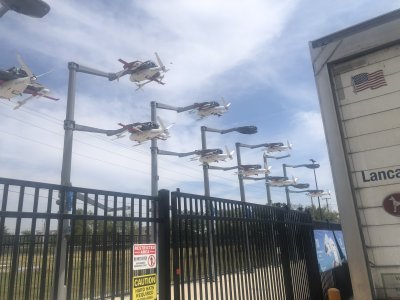
Well, apparently we have autonomous drones now. The mother drone sends a baby drone down to earth. Someone puts a package in the baby drone, closes the lid and it flies back to the mother. Then it delivers it to the delivery address, usually the backyard? It happened too fast for pictures / I didn't know WTF was going on. Up to 8 pounds weight capacity

Google didn't help much, maybe autonomous is the wrong word, it also used the word tethered

I'm only guessing someone would have to be home to open the lid.
 
Well, apparently we have autonomous drones now. The mother drone sends a baby drone down to earth. Someone puts a package in the baby drone, closes the lid and it flies back to the mother. Then it delivers it to the delivery address, usually the backyard? It happened too fast for pictures / I didn't know WTF was going on. Up to 8 pounds weight capacity

Google didn't help much, maybe autonomous is the wrong word, it also used the word tethered

I'm only guessing someone would have to be home to open the lid.
Did you see this on Futurama?
 
Back
Top