• Scam Alert. Members are reminded to NOT send money to buy anything. Don't buy things remote and have it shipped - go get it yourself, pay in person, and take your equipment with you. Scammers have burned people on this forum. Urgency, secrecy, excuses, selling for friend, newish members, FUD, are RED FLAGS. A video conference call is not adequate assurance. Face to face interactions are required. Please report suspicions to the forum admins. Stay Safe - anyone can get scammed.
  • The 2026 Calgary Area Meetup is set for Saturday May 30th at 10am. The signup thread is here! Robinhood has graciously offered to host the meetup again this year. Please note that you MUST RSVP to the notice linked above if you wish to come.

DavidR8's shop shenanigans

Further to my earlier post. My drill stopped drilling the other day. Today I completed the hole through the half inch plate. Turns out I had simply run out of chuck travel on the sensitive shaft.

While I had time, I chased down another question I'd always wondered about. Small drill quality.

Under heavy magnification, that teeny tiny little dormer still has perfect edges and..... a PERFECT SPLIT POINT! I had always thought that split points ended at a 16th or so. Not so with Dormer. Even the smallest Dormer in my set (40 thou) has a perfectly symetrical split point under magnification. I also have some miscellaneous small drills. Some of them are dormers all of which have perfect split points all the way down to 30 thou. None of my other non-dormer bits have split points. Bonus Marks for Dormer.
I don't think my VEVOR drill bit sharpener has a fine enough diamond grit wheel to do split points on small drills. Of course the collets are only good down to 3mm but that's the shank size of the smaller drill bits. I suspect sharpening those requires a very specialized machine.
 
I don't think my VEVOR drill bit sharpener has a fine enough diamond grit wheel to do split points on small drills. Of course the collets are only good down to 3mm but that's the shank size of the smaller drill bits. I suspect sharpening those requires a very specialized machine.

Mine doesn't either.

I'm thinking that requires a level of precision that dictates very specialized equipment that is likely also well outside my financial scope.

@CWret and I were chatting about that the other day. We felt than sharpening small drills isn't worth it anyway. Even the really good ones are not that expensive. It prolly just makes more sense to buy them 10 at a time and pitch them when they get dull. Small Dormer drills are just $5 each at yuyo.ca (a craft place) with $20 shipping and $9 each in a quantity of 10 on Amazon.


I don't remember what I paid at my jobber but prolly double that which is still cheap for what you get.

I did buy a 2.5mm collet for my Sharpener so I could try to sharpen small drill bits but it was just to be able to experiment. I don't plan to sharpen 2mm drills. I just don't see the point of it. Especially now that I know that small dormers are split point.
 
My drills are all dormers. So I'm pretty confident that my holes are about as good as can be expected.
^ agreed!
Particularly if the hole location is critical and a broken bit or tap is to be avoided as much as possible. In this case, I’d go one further than just premium tooling and suggest using a new bit and also a new tap for each hole that is in a critical location.
that wobble will produce a deflection as it enters the hole that will first become worse, and then become better.
^ this makes perfect sense.
So if we know that there will be some wobble and it can produces a hole that is slightly larger or asymmetrical at the top, then make use of that information.

How about this as a solution: make a stabilizing by drilling a hole in a scrap piece of mild steel (say 3/16” thick hot rolled flat bar, aluminum alloy might work just as well and would be easier to drill); then center the bit on the hole location; raise the bit; slip in the stabilizer under the bit; lower the bit into the stabilizer; clamp the stabilizer to the work piece; drill the hole.

If the stabilizer is causing a problem with Z travel, then stop drilling, remove the stabilizer, and complete the hole, but make the stabilizer as thick as is practical - 1/4” thick would be better that 3/16”.

Here’s going one step further: stack 2 pieces of 1/8” flat bar (or 3/16”); drill a through hole; discard the top piece; and use the bottom piece as the stabilizer.

PS - During the 1980s, I pioneered on methods and custom tooling to drill straight and accurate holes. I authored and/or co-authored several technical papers on the subject. This was primarily for 80 foot deep and 3 inch diameter blast hole in concrete. But IMO, a drill hole is a drill hole.
 
Last edited:
Here’s going one step further: stack 2 pieces of 1/8” flat bar (or 3/16”); drill a through hole; discard the top piece; and use the bottom piece as the stabilizer.

This absolutely awesome. You have just modified my rules of small hole drilling. This stabilizer idea is similar to my drill guide rule, but totally additive because it eliminates the early effects of Drill wobble and makes the hole uniform top to bottom! What a great way to drill uniform holes for tapping! I love it!

Any thoughts @PeterT & @jcdammeyer ?

I'm looking forward to hearing how much this might have helped @jcdammeyer make uniform holes - assuming he isn't done already.

My new small hole drilling rules (especially important for drilling before tapping):

1. Use a high quality sensitive drill chuck,or at least the lowest runout small chuck you have.

2. Use a spotting drill to locate and start the hole.

3. Use a stabilizing plate (or preferably two plates) to use up the wobble diameter growth depth. Note - this is NOT THE SAME as using a drill guide. Drill guides are not needed when using drill presses or mills with sensitive chucks.

4. Use high quality drills. This is even more important for small holes.

5. Use a new drill if possible.

I dunno about that last one being a rule but I understand the idea.
 
I have seen some members have these funny tool boxes with lots of dividers in the drawers full of drill bits!
I used to sharpen them small bits, now I can’t see them! What!, maybe I haven’t broke them all, just have to put the mag nee fri ers on.
 
I have seen some members have these funny tool boxes with lots of dividers in the drawers full of drill bits!
I used to sharpen them small bits, now I can’t see them! What!, maybe I haven’t broke them all, just have to put the mag nee fri ers on.
If 50% of them are dull, perhaps turning them around might help? Kinda like the nails that are for the other side of the house..... 🙄
 
This absolutely awesome. You have just modified my rules of small hole drilling. This stabilizer idea is similar to my drill guide rule, but totally additive because it eliminates the early effects of Drill wobble and makes the hole uniform top to bottom! What a great way to drill uniform holes for tapping! I love it!

Any thoughts @PeterT & @jcdammeyer ?

I'm looking forward to hearing how much this might have helped @jcdammeyer make uniform holes - assuming he isn't done already.

My new small hole drilling rules (especially important for drilling before tapping):

1. Use a high quality sensitive drill chuck,or at least the lowest runout small chuck you have.

2. Use a spotting drill to locate and start the hole.

3. Use a stabilizing plate (or preferably two plates) to use up the wobble diameter growth depth. Note - this is NOT THE SAME as using a drill guide. Drill guides are not needed when using drill presses or mills with sensitive chucks.

4. Use high quality drills. This is even more important for small holes.

5. Use a new drill if possible.

I dunno about that last one being a rule but I understand the idea.
I've thought about buying a sensitive drill chuck. Some of this Robot Arm uses 2.5mm holes for tapping 3mm. I also needed 2mm holes to tap 2.5mm to mount down PC boards onto a carrier. But the carrier is 3D printed so pure concentric and round isn't a big criteria.
I did learn a while that you don't use a tapered spiral tap in a blind hole... (EDIT: Using CNC drilling)
 
I've thought about buying a sensitive drill chuck.
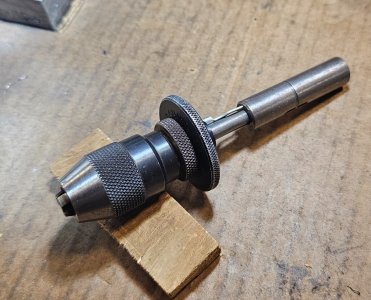
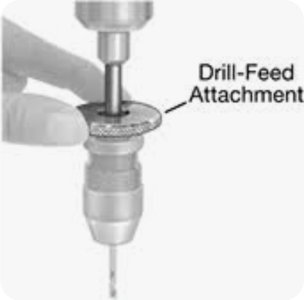
I really do love my Albrecht. It's hard for me to imagine shop life without it. A sensitive drill chuck is almost a requirement for small drills. Instead of using the quill to press the drill into the hole, which invariably breaks them, you use a small wheel on the drill chuck to push the drill down with your fingers. Your fingers are far more "sensitive" - hence the name.

The quill rotates the drill, but your fingers apply the down pressure. Typically, they have a splined shank to apply the turning force and a floating wheel to apply the down force.

Screenshot_20260323_152352_Chrome.jpg

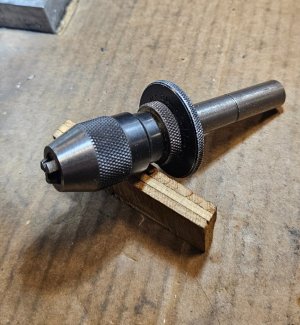
And here is the sensitive chuck I used till I got the albrecht. It is infinitely better than not using one.


But the albrecht below is better. For one thing, the jaws are zero rated. I don't know about zero, but they will definitely close on a 10 thou wire. I know that cuz I did it.

20260323_154553.jpg

In the following photo, I held the arbour apart against the spring tension with a little electrical terminal.

20260323_154803.jpg

What, some of you can drill small holes!? I’ve broke most of my small drills. LOL.

Breaking small drills is normal until you are setup properly. After that, it still happens but only rarely.

You'll notice that some mention buying the little ones in 10 packs....... 🙄

Not because I break them. It's because I can't sharpen such a tiny drill and they do get dull easily. Better to just throw them away and grab another one.
 
Back
Top