I carry 24' battery cables made from welding cable year round. Reach isn't a concern. Neither is cold weather, nor discharged booster pack batteries.The car can be wedged into a parking space and no worries about getting hooked up.

-
Scam Alert. Members are reminded to NOT send money to buy anything. Don't buy things remote and have it shipped - go get it yourself, pay in person, and take your equipment with you. Scammers have burned people on this forum. Urgency, secrecy, excuses, selling for friend, newish members, FUD, are RED FLAGS. A video conference call is not adequate assurance. Face to face interactions are required. Please report suspicions to the forum admins. Stay Safe - anyone can get scammed.
You are using an out of date browser. It may not display this or other websites correctly.
You should upgrade or use an alternative browser.
You should upgrade or use an alternative browser.
Car booster battery pack recommendations, svp?
- Thread starter someidiot
- Start date

Elektrishun
Ultra Member
I carry 24' battery cables made from welding cable year round. Reach isn't a concern. Neither is cold weather, nor discharged booster pack batteries.
Not saying the booster is better than your 24' foot cables. Just pointing out that the booster is not a gimmick, they do work.
Fair enough. Under certain circumstances, from what I'm able to put together.Not saying the booster is better than your 24' foot cables. Just pointing out that the booster is not a gimmick, they do work.

someidiot
Well-Known Dismemberer
I really appreciate all the comments, and ordered a pair of the NOCO GB40s for our girls. It was sparked by one of them having a Day From Hell last week - she's in a very rigorous paramedic program at SAIT, they're in the middle of exams, and the last thing she needs is to not be able to commute into the city for school. But she went out to her car - we drive almost nothing but very reliable Subarus - and found it dead, probably having failed to turn the key all the way off and had the accessories drain the battery. So she jumped into an identical Outback she bought a month or so ago as a backup for exactly this kind of situation. It got her to the train station and to school on time - but when she returned at the end of the day, it wouldn't start, likely thanks to something pedestrian like a bad battery connection that hasn't been shaken out yet because it's still too new (to her).
So we're not looking for the magic trick that's going to start a giant diesel in -30C - we're just trying to supply them with a little backup for those times when everything just seems to be going to shit.
So we're not looking for the magic trick that's going to start a giant diesel in -30C - we're just trying to supply them with a little backup for those times when everything just seems to be going to shit.

SomeGuy
Hobbyist
Fair enough. Under certain circumstances, from what I'm able to put together.
Under a lot of circumstances...like is the smallest jump pack going to start a semi-truck at -30c? Obviously not. But a normal dead/weak battery on a car? Yeah, 99% of the time they're all that is needed and they're pretty much impossible to screw up (you can't reverse leads, they don't spark, etc.).
Elektrishun
Ultra Member
I really appreciate all the comments, and ordered a pair of the NOCO GB40s for our girls. It was sparked by one of them having a Day From Hell last week - she's in a very rigorous paramedic program at SAIT, they're in th new (to her).
Maybe you already looked at the charging aspect?
Nonetheless...
The NOCO GB40 specs state a USB input of 5V @ 2.1 amps when recharging. I found a Philips 60W charger that can easily charge at the max rate and doesn't even get warm while doing it:
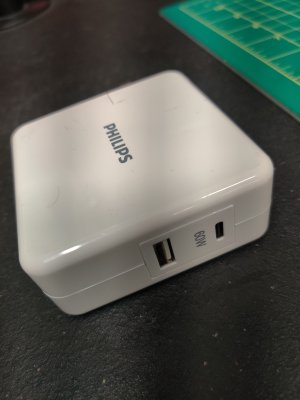
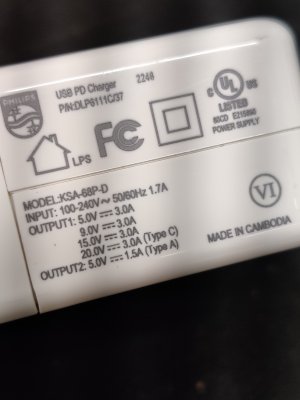
Any quality "fast" phone charger would likely do the same. But if they are using a generic cheapo charger it may take a lot longer.
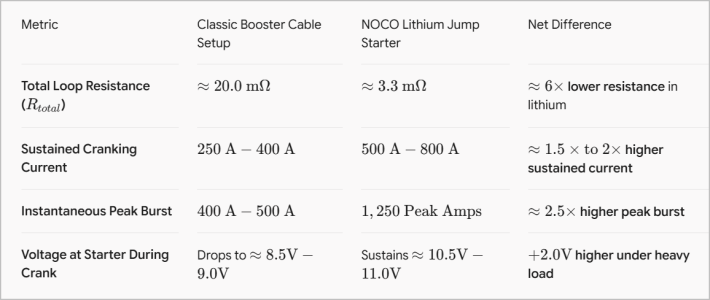
When you are boosting car battery to car battery you require low resistance cables otherwise you give up energy warming wimpy wires to atmosphere. Long length requires bigger diameter copper. Auto batteries have lower nominal voltage designed around their 99.99% sole task: the ignition system, so they have less overhead voltage to give. They also have higher internal resistance as a function of their chemistry & design which self limits the safe discharge current. A portable charger like a NOCO has lithium chemistry so a) is a higher nominal voltage state b) has low internal resistance c) has much higher discharge C-rating. So collectively it can punch out both higher voltage and higher current. The high current isnt a problem on the 8 wg wires because they are very short, the booster sits right by the dead battery. The downside is you cannnot boost for an extended period like another car battery can because of small battery capacity & cooking the wires. Hopefully short boost duration is all it needs. A car based boosting battery can theoretically boost longer duration since the alternator charging in the background. But, I really wonder about that. If the boost isnt going well, stubborn start, perpetual cranking etc the boost battery is seeing sustained low voltage suppression. Auto battery chemistry is quite intolerant of low voltage before permanant degradation occurs. No different that frequently leaving your lights on for a sustained period, a healthy auto battery goes for sh*t.. The AMA type tow/boost trucks use standalone booster packs completely divorced from primary battery. I think they are either banks of deep cycle batteries (which can safely be drawn down to much lower voltage) or maybe even lithium chemistry these days.
To my mind the NOCO 1) gets my vehicle battery & its electronic boards out of the boosting loop altogether, no risk to my vehicle, so use it first for that reason alone 2) higher voltage during cranking means the starter motor spins significantly faster which under freezing conditions is often required 3) usually quicker & safer than getting your car & cables orientated to boost. Didnt someone just get killed on Deerfoot changing his tire? Why take extra risk, its a $200 gizmo. A couple tanks of gas.
To my mind the NOCO 1) gets my vehicle battery & its electronic boards out of the boosting loop altogether, no risk to my vehicle, so use it first for that reason alone 2) higher voltage during cranking means the starter motor spins significantly faster which under freezing conditions is often required 3) usually quicker & safer than getting your car & cables orientated to boost. Didnt someone just get killed on Deerfoot changing his tire? Why take extra risk, its a $200 gizmo. A couple tanks of gas.
Last edited:
someidiot
Well-Known Dismemberer
Maybe you already looked at the charging aspect?
Nonetheless...
The NOCO GB40 specs state a USB input of 5V @ 2.1 amps when recharging. I found a Philips 60W charger that can easily charge at the max rate and doesn't even get warm while doing it:
View attachment 88919 View attachment 88920
Any quality "fast" phone charger would likely do the same. But if they are using a generic cheapo charger it may take a lot longer.
No, I was moving too fast yesterday to seriously consider the charging aspect. But I'll do so now - thanks.
someidiot
Well-Known Dismemberer
Didnt someone just get killed on Deerfoot changing his tire? Why take extra risk, its a $200 gizmo. A couple tanks of gas.
It's your last sentence that offers the best perspective. In this era of cheap stuff, the cheapest among us can still bridle a little at shelling out hundreds of dollars for a "convenience gadget", forgetting that capital expenses are often, and certainly in this case, inconsequential compared to ongoing operating. Sure, we still got a couple of the low-end (1000 A) ones, but it sounds from everyone's experience like they'll do just fine.

I am so interested in this subject that I decided to watch the project farm video.
Seems like he does a pretty comprehensive set of tests but holy crap he is hard to listen to! He should slow down, cut the blow by blow narration, keep the charts, and just describe highlights.
I like his data only approach though. Just waaaay too much yakking at hyper speeds.
He also has two videos on this subject. I don't know if I watched the right one. Doesn't matter though - I'm NOT watching a second one.
ONE CAUTION from my own experience and knowledge.
Several folks have mentioned that short cables provide protection. That is only true in one case. A short cable does reduce TOTAL resistance for a given gauge vs a long one, which does increase the current any source can deliver via that cable, but it does nothing to reduce the risk of cable damage or terminal failure. These latter characteristics are intrinsic to the cable regardless of length. If the cable gauge is too small, the wire can melt or be damaged regardless of length. This risk is only slightly reduced by a LONGER cable, not a shorter one, only because the total current is reduced by the total cummulative resistance of the longer cable. Thus a longer wire is slightly safer than a shorter one. The incentive for a shorter cable has nothing to do with the safety of the wire. It's only advantage is a very slight increase in total current flow at the cost of potential cable damage. In my mind, larger gauge cable and improved connections is always better.
I'd be very interested in any testing members have done on these units as well as any observations regarding the size of engine the various units can reasonably handle.

slow-poke
Ultra Member
Just a often overlooked FYI about boosting a vehicle with another.
Don’t let the supply car run while the dead car is trying to start. Yes the dead car will crank better but you risk cooking your alternator.
So hookup, run the supply car for a few minutes, then shut it off and let the other car start.
I cooked an alternator like this being a Good Samaritan.
The current drawn from the alternator during a start can easily exceed the alternator rating,
All his videos are structured the same way so what I do is skip to the final rankings, then check back to the tests I want to see. Even though I skip over 90%+ of it, I do appreciate the transparency. It makes me comfortable to treat his channel as a primary source of information rather than yet another secondary source. I agree it's pretty low on entertainment value though.Seems like he does a pretty comprehensive set of tests but holy crap he is hard to listen to! He should slow down, cut the blow by blow narration, keep the charts, and just describe highlights.
Another advantage of the shorter cable is that the whole package is smaller/neater when not in use, and that the product is cheaper because it uses less copper. Those are definitely factors I consider because neither my car nor wallet are very big. Obviously I want a functional and safe product too, but I'd be trusting the manufacturer for that regardless.
Don’t let the supply car run while the dead car is trying to start. Yes the dead car will crank better but you risk cooking your alternator.
Thats good to know, and rings a vague familiarity bell. So further to what I was saying in post #28, now the source battery is giving is energy to depleted boost battery (plus any resistance losses along the way) with no benefit of alternator charging, so its going to deplete to lower voltage state even faster. I guess same rules apply. if its a quick on/off boost no harm done. But if its sustained boosting or source battery is not in top notch shape, you risk degrading the 'good' battery in your emergency / act of kindness.
All his videos are structured the same way so what I do is skip to the final rankings
I like that. If all his videos have the same format, that would work for me.
Don’t let the supply car run while the dead car is trying to start. Yes the dead car will crank better but you risk cooking your alternator.
Yes, nobody thinks of that. It doesn't happen very often, but it does happen.
SomeGuy
Hobbyist
Just a often overlooked FYI about boosting a vehicle with another.
Don’t let the supply car run while the dead car is trying to start. Yes the dead car will crank better but you risk cooking your alternator.
So hookup, run the supply car for a few minutes, then shut it off and let the other car start.
I cooked an alternator like this being a Good Samaritan.
The current drawn from the alternator during a start can easily exceed the alternator rating,
Hard disagree, keep the supply car running, if you kill your battery without getting the other car started, now you're both screwed.
The right thing to do is connect up the batteries while supply car is running and wait a good few minutes before attempting to start, this will let the dead battery charge up a bit and get some temperature in it (applicable at very low temps), which increases your odds of starting. Killing an alternator isn't likely, they can only deliver so much current until the voltage dips below your battery voltage at which point the battery is going to be supplying the bulk of the current. If your entire system is weak to begin with when you're the supply car, don't offer to boost...you'll just cook your already weakened components.
Source: boosting cars in -40c temps in northern ontario when I was younger
slow-poke
Ultra Member
Do as you like, but realize the battery especially when charging the other dead battery is going to drop a volt or two, the alternator will be putting out near 14V, guess were the current is coming from? That’s why letting the car running is more effective. Back in the day 65A alternators were common. And cost about $20 and the scrap yard. Nowadays they are usually 100A+ and a lot more expensive.
Obviously some alternators are more robust than others, I boosted countless car with the car running as well, I don’t do it anymore. I do let the other battery charge a bit while running before the start, 5 minutes goes a long way.
Growing up in Winnipeg, boosting cars was more of a regular occurrence than in balmy Ottawa.
Last edited:
Hard disagree, keep the supply car running, if you kill your battery without getting the other car started, now you're both screwed.
I'm on SlowPoke's page.
If you kill the source battery it's an easy fix with a new battery. If you kill your alternator it's a much more difficult repair.
The right thing to do is connect up the batteries while supply car is running and wait a good few minutes before attempting to start, this will let the dead battery charge up a bit and get some temperature in it (applicable at very low temps), which increases your odds of starting.
Yup, that's the likely scenario. But not the only scenario. Sometimes the battery just dies with no voltage build. When this happens, the alternator can overload and the windings can be destroyed.
Killing an alternator isn't likely,
True. But this is one of those times when "isn't likely" isn't certain enough.
they can only deliver so much current until the voltage dips below your battery voltage at which point the battery is going to be supplying the bulk of the current.
This is one of those odd situations where the various circumstances can all line up against you. Alternators are typically rated for max current into a 13.5V load at various engine speeds. If the battery/system voltage is much lower than 13.5, the output current can skyrocket and damage the alternator. That's also why you shouldn't race the engine with a low battery.
If your entire system is weak to begin with when you're the supply car, don't offer to boost...you'll just cook your already weakened components.
Thats good advice. The problem is that most drivers don't know when their system is weak.
Besides, when a hottie needs a hero, not many of us really think that straight.......
Source: Doing my job developing engines that can operate at -60 in the cold room with regular real-world validation testing, and rescuing the odd hottie (and a few regular ugly people too) in my spare time.
As @slow-poke correctly explained, this is not a common failure. Probably less than 1 in 20. That's why most guys never experience it. But when it happens, it's much worse and more expensive than replacing a battery.
SomeGuy
Hobbyist
I guess it comes down to personal experience, I have seen vehicles boosting not start after trying to boost and then both are screwed. This is the first time I've ever heard of an alternator failing while boosting but what you guys are saying does make some sense. I guess it all depends on circumstances at the time.