If a pair is what you want, resubmit it as 2 parts joined by a bridge or similar. It may reduce the cost - at least it does with really small parts where they charge a base amount per part.I whipped this up just to get a rough estimate. This is 75MM x 45MM x 45MM. Flange is 5mm, wall is 3mm.
A pair in 6061 is $146CAD delivered.

-
Scam Alert. Members are reminded to NOT send money to buy anything. Don't buy things remote and have it shipped - go get it yourself, pay in person, and take your equipment with you. Scammers have burned people on this forum. Urgency, secrecy, excuses, selling for friend, newish members, FUD, are RED FLAGS. A video conference call is not adequate assurance. Face to face interactions are required. Please report suspicions to the forum admins. Stay Safe - anyone can get scammed.
You are using an out of date browser. It may not display this or other websites correctly.
You should upgrade or use an alternative browser.
You should upgrade or use an alternative browser.
Amazing metal printing
- Thread starter DavidR8
- Start date


I looked into CRAFTCLOUD for SS316 printing and it is far from inexpensive. This company is the middleman - with hundreds of specialised vendors available to make parts from almost any material, not only 3DP but CNC operations as well. There are vendors from across the globe including here in Canada.
Pricing seems to be based on the printed volume + support material, plus the usual shipping expenses.
I priced out several parts from small gears (SS316L, M2.5 25T) to large gears (SS304, 10DP 55T), a 4" long SS316 steady rest and the same part in 6061.
In all cases the pricing was much higher than expected and IMHO uneconomical when compared with parts made traditionally.
The services offered cover a huge range (160+ materials) and dozens of different manufacturing processes so there will probably be an option for most parts.
I was curious about printing metal parts with overhangs. The usual 3DP rules for plastic apply - 45degree max unsupported slopes, bridges need to be supported and most importantly, hollow parts require an exit hole so that the unfused metal powder can be removed. Printed metal parts are 80-95% as "strong" as solid, cast or machined parts (as reported by the vendors) but that needs to be verified for anything where failure might cause a problem. The sintering process leaves small voids but there seems to be little to no stratification with reduced shear strength in plane, so that is interesting.
🙂


Slightly off-topic, but I need some change gears for my Barnes #5 lathe, Odd-ball pitch, 14DP, when all the contemporary and newer lathes use 16DP. I have found a couple sizes I need off eBAY, but not all of them. I used openSCAD to configure a sample gear, and used 3d printer, CNC router, and conventional machining to make a sample 20T gear.
The big gear is a 100-year old Barnes steel gear. Yellow is 3-d printed PLA, white is CNC-machined nylon, last one is 6061 aluminum.
The PLA is very good, tight to dimensions, but I'm not sure how durable it would be. I don't have any other filaments, I'm sure if I could use PETG or another higher-strength filament it would be quite useable.
White nylon is a disaster, a lot of burrs and poor surface finish. My settings for feed & speed came from generic websites, I'm guessing I could spend some time tweaking values it would probably produce better results. A zillion offshore lathes using nylon gears proves that the material is suitable.
Aluminum for the win. Took a piece of 6061 plate, on the band saw to rough cut to o,d,, bored the centre hole to size, made an arbor, then chucked arbor and blank in the lathe and turned o.d. to size. Took arbor and blank and chucked it into a spin indexer. 14DP cutter set off eBay. 1 hour of manual machining on my RF30 mill.
Ignoring programming time, PLA took about 1.5 hours, nylon about 1.5 hours, aluminum about 2 hours. The only real advantage of the automated manufacturing is I could do something else while the machines buzzed and clicked to themselves. But, I got 2 hours of enjoyment running the lathe and mill that I didn't get running the 3DP or CNC.
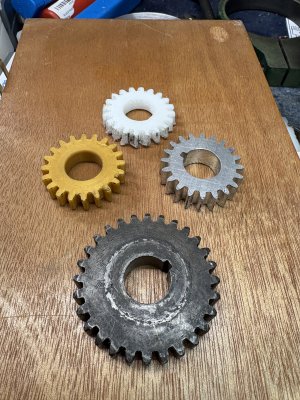
The big gear is a 100-year old Barnes steel gear. Yellow is 3-d printed PLA, white is CNC-machined nylon, last one is 6061 aluminum.
The PLA is very good, tight to dimensions, but I'm not sure how durable it would be. I don't have any other filaments, I'm sure if I could use PETG or another higher-strength filament it would be quite useable.
White nylon is a disaster, a lot of burrs and poor surface finish. My settings for feed & speed came from generic websites, I'm guessing I could spend some time tweaking values it would probably produce better results. A zillion offshore lathes using nylon gears proves that the material is suitable.
Aluminum for the win. Took a piece of 6061 plate, on the band saw to rough cut to o,d,, bored the centre hole to size, made an arbor, then chucked arbor and blank in the lathe and turned o.d. to size. Took arbor and blank and chucked it into a spin indexer. 14DP cutter set off eBay. 1 hour of manual machining on my RF30 mill.
Ignoring programming time, PLA took about 1.5 hours, nylon about 1.5 hours, aluminum about 2 hours. The only real advantage of the automated manufacturing is I could do something else while the machines buzzed and clicked to themselves. But, I got 2 hours of enjoyment running the lathe and mill that I didn't get running the 3DP or CNC.
Last edited:

skippyelwell
Ultra Member
I have not been paying attention, I had no idea how far they had come with metal printing, kind of astonishing really.
It looks like it will leave fabricators in the dust.
It looks like it will leave fabricators in the dust.

I just uploaded my step file and picked the material.I'm trying to figure out where @DavidR8 and his forum guy is getting that cheap quote for metal printing! I don't have any immediate need but I'll think of something in the future for sure lol
Where's the link to the service I don't see any in this thread?I just uploaded my step file and picked the material.
Where's the link to the service I don't see any in this thread?
@architect That's the only one I tried. I expect there are others
Possibly this has changed since I looked into it, but... from my understanding 3D metal printing needs to be sintered in a special oven and cannot be done at home. The oven is worth about $80KUSD. Yes you can print your part, but then need to send it to a shop that has an oven for sintering and then they will mail it back to you.
TonyK.
Grimsby Ontario Canada.
TonyK.
Grimsby Ontario Canada.

There are businesses that offer this service in the GTA.
Cost would depend on the details involved.
Metal 3D printing use powdered metal and a laser to bind the particles into position.
Cost would depend on the details involved.
Metal 3D printing use powdered metal and a laser to bind the particles into position.

There are at least 3 ways to metal 3d print.Possibly this has changed since I looked into it, but... from my understanding 3D metal printing needs to be sintered in a special oven and cannot be done at home. The oven is worth about $80KUSD. Yes you can print your part, but then need to send it to a shop that has an oven for sintering and then they will mail it back to you.
TonyK.
Grimsby Ontario Canada.
One way is the bed of powder with a laser (or electron beam or other?) melting the layer of the part, then another layer of metal powder, melt with laser & repeat. The part is pretty ready to go after it comes out of the machine - with cleanup and precision milling of certain surfaces for detail, flatness, threads, etc. That is what we are seeing the video above. The powder can be explosive, hazardous to breathe, and may need a special atmosphere while printing.
Another way is with a metal powder paste which is printed very similar to 3d FFF printing (the usual) and then the "greenware" part is sintered in a precision sintering oven. Our favourite bat cave owner Dan Gelbart is manufacturing and selling a system that does this called Rapidia. This is much safer as the metal powder is "wet" and safe & easy to handle as it comes in a tube you load in the printer. @Fly_Cut this might be the entry level machine as well it looks like a good solution. I'd love to have one. Did I mention they are Canadian? I think they are about $200K CAD.
And a third way is with a MIG welding robot. It puts down layers of hot metal and builds up the part layer by layer. Here is 3d printed bridge. It's like nothing you've ever seen:
And there are variations of the above combining aspects together.
Last edited: