• Scam Alert. Members are reminded to NOT send money to buy anything. Don't buy things remote and have it shipped - go get it yourself, pay in person, and take your equipment with you. Scammers have burned people on this forum. Urgency, secrecy, excuses, selling for friend, newish members, FUD, are RED FLAGS. A video conference call is not adequate assurance. Face to face interactions are required. Please report suspicions to the forum admins. Stay Safe - anyone can get scammed.

Acronyms

In your example, raw abstract calculation being outsourced to a machine is different from outsourcing reading and writing practices.

HOLY CRAP!

The calculator example was just me lamenting what I see as the advantage of the good old ways vs the new ways and my own resistance to change.

The list was just me poking fun at old people like myself who don't like change despite knowing that most change is actually good. I had no intention that anyone take all those silly examples as serious compared to the way kids are using AI today.
 
You lumped together the act of 'reading and writing' with 'mental arithmetic', alongside a scattered list for the purpose of alluding to a vague commonality among them: that they all share this seemingly inevitable technological progression towards a "better" defined by qualities like "faster" and "convenience", and the accompanied "bad" as acceptable tradeoffs. This is then merely matter of "personal transition pain" or irreconcilable subjectivity (different eras, old vs new). It is true in some superficial way but not really meaningful in what I was getting at with my students in social sciences.

This is a list of apples, oranges, bowling balls, bowler hats, planets, and atoms. I am being told that what is common about them are their roundish quality. However, as I work through the details the objects quickly become incomparable in any meaningful way and this abstraction just obscures the deeper truths about those their complexities and actual impacts. I can't help but to see more than their roundish quality that make them dissimilar and worthy of individual investigation. Instead of meaningful pointed questions such as, "how does the improvements or degradation of individual reading and writing skills shape youth competency and society at large", this line of inquiry is instead substituted with vague gestures towards other dissimilar objects leading to no insight. Applying the question above to the different objects would lead to different answers, and the shared roundish qualities about them would then be quite insignificant. Unfortunately, I can't take off my social science hat off and these questions and concerns here!

In your example, raw abstract calculation being outsourced to a machine is different from outsourcing reading and writing practices. Metal math is closer to correct spelling. Knowing mental math doesn't directly translate to being a good engineer, and neither does learning to spell make a good author or researcher. The person makes the engineer not the calculator. On the other hand, reading and writing in the context of social sciences are integral processes of critical thinking and judgment that impacts the person. The better analogy would be to imagine learning machining or fixing cars by never actually doing it. Just watching videos or reading about it theoretically. Significant critical knowledge is missing by not actually practising machining or wrenching. That's why that field of knowledge and practice is best accomplished by including on-site apprentership. Similarly, reading and writing is integral practice in social science research because there are significant qualitative and philisophical concerns, and inserting AI is essentially removing and skipping the critical learning experiences.

All of us in higher ed social sciences and humanities have seen dramatic drops in aptitudes and critical thinking since the AI boom. It is night and day. Students are feeding their readings to AI and getting AI to write -for- them, including presentation scripts that then then read. It has become more than a crutch. They actually didnt and dont care to learn or absorb anything. We know this because almost everyone failed the final hand-written exam where they have to draw from their own -understanding- without getting AI to write it for them. Understanding concepts is different than crunching numbers. It's like a student going through auto mechanic school and not knowing the difference between aluminum and stainless steel, or having never actually touched a car. This is what has happened around us. AI is doing the opposite to youths, especially the cognitive and emotional development. This is a bad educational foundation. Students don't feel the need learn or understand anything when there's a personal butler in their pocket. The magnitute and reach is jarring because it is relevant to formation (and unrest) of civil society and liberal democraries.

I too am from an era of drafting boards, parallel rulers, and basswood models in architecture school. I remember hand rendering concrete textures and axonometric diagrams. I had no qualms about transitioning into digital tools and was an early adopter on many technologies. AI is not comparable and should not be considered generically or interchangably. This is especially important when one takes into account the specific companies, actors, and politics driving them.

Bringing this back to topic, curious folks interested in language and communication might be intrigued about semiotics and discourse analysis. These analytical methods are less concerned with decontextualed words (containers) bestowed to the people by particular companies and institution through the formal distribution of dictionaries. Instead, the focus leans towards meanings (contents) that naturally emerge as part larger everyday usage and shifting social processes found in various mediums (imagery, text, speech).

That's it for me I will derail the thread no more!

Where's me emoticon with them little swirly eyes? 😀 😉😛
 
HOLY CRAP!

The calculator example was just me lamenting what I see as the advantage of the good old ways vs the new ways and my own resistance to change.

The list was just me poking fun at old people like myself who don't like change despite knowing that most change is actually good. I had no intention that anyone take all those silly examples as serious compared to the way kids are using AI today.
Here? You didn't things would skip the rails here? ...... silly @Susquatch 🙄😉
 
Unfortunately, I can't take off my social science hat off and these questions and concerns here!

Bringing this back to topic, curious folks interested in language and communication might be intrigued about semiotics
Signs seem.... irrelevant? Either because nobody reads them, nobody understands them, or both. I'm not trying to be funny, signs are pointless unless all society members recognize them and use them.

Maybe you can comment on this, from what I'm told Canadians "generally" obey signs. You go in the out door at Walmart and you get dirty looks. Any average parking lot people stop for stop signs, when they legally don't need to

Semiotics seems interesting but only if it works? It seems people who are conditioned to follow signs get upset with people who can't follow signs
 
Signs seem.... irrelevant? Either because nobody reads them, nobody understands them, or both. I'm not trying to be funny, signs are pointless unless all society members recognize them and use them.

Semiotics seems interesting but only if it works? It seems people who are conditioned to follow signs get upset with people who can't follow signs
Signs is a technical term in the field of semiotics. Like 'boring' is a term in machining that doesn't mean something that makes you sleepy in everyday usage. This is actually an example of how 'signs' work.

1795792593967.png

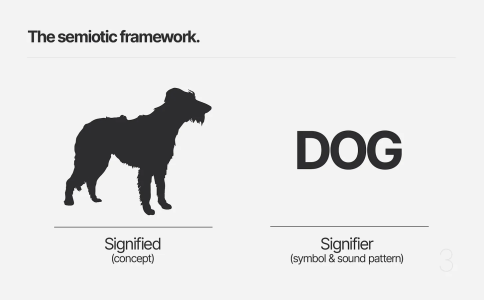
There a few a approaches but in general when a 'signified' (concept form/thing) and a 'signifier' (representation) comes together to form a 'sign' (meaning). For example, when the representation 'DOG' is associated with the imagined animal, together this is a sign. If I write "DAG" but but it isn't associated with any existing animal or concept then the word has no meaning and nothing is communicated. If if imagine a dog but we do not share the same signify (English word, DOG) no meaning can be communicated.

Deconstructing this way allows us to get all the way down to the foundation and understand how we communicate across a range of representation methods that isn't just text language (French, English etc) but can include graphics, hand gestures, sound etc. If we don't share the same text signifier (English language), I may try alternative gestural or audio signifiers (putting our hands up like paws, making barking sounds) in an attempt to find a shared signifier to communicate the meaning of a "dog" to you. That is somewhat obvious but thinking about it in these theoretical components lets us see and understand how meanings change and is context specific in everyday life. If I gesture barking sounds walking past a stranger, they might think I'm taunting or insulting them. This is when one signifier can result in different meanings (sign) depending what concept (signified) it gets attached to between the two people communicating, or even across different groups.

1795793377044.png

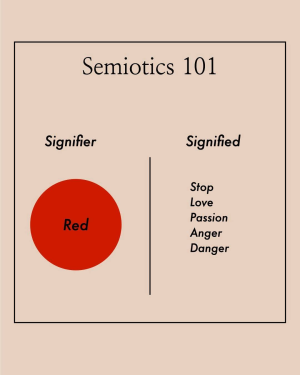
One country might evoke the colour red as associated with the concept of passion, but another country red might have the meaning of anger. This approach to understanding communicate is different than traditional linguistics that is limited to hardcoded dictionary words that doesn't take into account everyday negotiations. Dictionaries are simply an index of things that happen in life when viewed this way and are always a few step behind and doesn't take into account regional local slangs that may be widespread and quite established. Signifiers don't have to be in a dictionary for it to be associated with a concept and have meaning for a group of people, from your buddies at a bar to an entire region.
 
Last edited:
Maybe you can comment on this, from what I'm told Canadians "generally" obey signs. You go in the out door at Walmart and you get dirty looks. Any average parking lot people stop for stop signs, when they legally don't need to

I'm not sure I understand the examples, but the average person might obey a stop sign in a Walmart because they might not know it's not a illegal to disobey it. But if you're asking why some people obey signs more, and one people frown on other people not obeying signs then it depends on many more details to really say specifically.

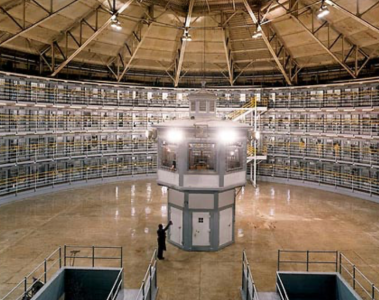
But in general, the classic example is if you're out in the desert road and there's a stop sign, would you stop or run it? Some people might stop because of panopticon effect as exemplified by the architecture of the prison where the warden tower is placed in a centre with full view of every prison cell. The warden tower has a one-way viewing mirror and because of that the prisoners never know if and when they being watched, and as a result act according to the rules. The warden might not even be there, but the chance that there -might- be a warden in the tower will keep all the prisoners abiding to the rules. Policing becomes very efficient this way and the prisoners start policing themselves. This is basically the concept of Neighbourhood Watch program.

1795794772872.png

This is a huge topic but it is essential how a society ends up policing each other, like giving stink eye to someone walking in using the out door. That's why people also might say "mind your own business" or "snitches get stiches" because they don't like when the everyday person act in the role of policing. When taken to an extreme on one end you might get too many "Karens" but on the other end you get complete chaos.
 

Attachments

  • 1795794758806.png
    1795794758806.png
    249.6 KB · Views: 0
I think that as soon as you reference a Walmart shopper you must abandon all logic and common sense.

So you're questioning my ability to reason because last week it was the most convenient place to get a jug of milk?

(Skipping over the semiotics discussion because I've been exposed to enough postmodernist nonsense to make me yell at the screen for the rest of the day, and I got shit to do.)
 
So you're questioning my ability to reason because last week it was the most convenient place to get a jug of milk?

(Skipping over the semiotics discussion because I've been exposed to enough postmodernist nonsense to make me yell at the screen for the rest of the day, and I got shit to do.)
No, just saying I wouldn't base any logic on a typical Walmart shopper.
 
No, just saying I wouldn't base any logic on a typical Walmart shopper.
What's wrong with Walmart? Where else can you park overnight, buy beer, ammo, a fresh cooked meal, pharmacy, underwear and tires? It's harder to find now but Walmarts used to do an $8 hot plate, meat potatoes and veggies. Or if you lucked out pre-made shish kebabs

Plus people watching at Walmart is a riot 😀

Sure (and I'm going to speak, as you to appear to be, more to the American examples than the canucks), if your idea of a good time is a social survey of malnutrition and morbid obesity.
 
Signs is a technical term in the field of semiotics. Like 'boring' is a term in machining that doesn't mean something that makes you sleepy in everyday usage. This is actually an example of how 'signs' work.

View attachment 90038

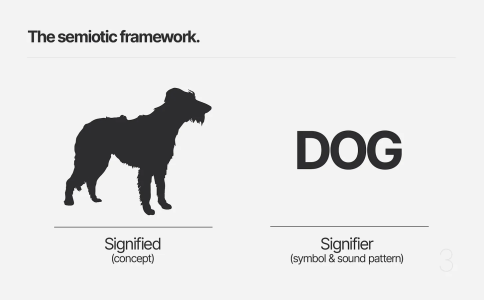
There a few a approaches but in general when a 'signified' (concept form/thing) and a 'signifier' (representation) comes together to form a 'sign' (meaning). For example, when the representation 'DOG' is associated with the imagined animal, together this is a sign. If I write "DAG" but but it isn't associated with any existing animal or concept then the word has no meaning and nothing is communicated. If if imagine a dog but we do not share the same signify (English word, DOG) no meaning can be communicated.

Deconstructing this way allows us to get all the way down to the foundation and understand how we communicate across a range of representation methods that isn't just text language (French, English etc) but can include graphics, hand gestures, sound etc. If we don't share the same text signifier (English language), I may try alternative gestural or audio signifiers (putting our hands up like paws, making barking sounds) in an attempt to find a shared signifier to communicate the meaning of a "dog" to you. That is somewhat obvious but thinking about it in these theoretical components lets us see and understand how meanings change and is context specific in everyday life. If I gesture barking sounds walking past a stranger, they might think I'm taunting or insulting them. This is when one signifier can result in different meanings (sign) depending what concept (signified) it gets attached to between the two people communicating, or even across different groups.

View attachment 90040

One country might evoke the colour red as associated with the concept of passion, but another country red might have the meaning of anger. This approach to understanding communicate is different than traditional linguistics that is limited to hardcoded dictionary words that doesn't take into account everyday negotiations. Dictionaries are simply an index of things that happen in life when viewed this way and are always a few step behind and doesn't take into account regional local slangs that may be widespread and quite established. Signifiers don't have to be in a dictionary for it to be associated with a concept and have meaning for a group of people, from your buddies at a bar to an entire region.
I always need a minute to read and understand your opinion

If I have two people, in Ontario, one can read a sign and understand it, the other person can't, they both were born raised schooled parented the same, the sign is irrelevant to the second person

I agree, a group of people could have their own system of signs, which could be a group or regional or country or language
 
But in general, the classic example is if you're out in the desert road and there's a stop sign, would you stop or run it?
I don't know your background or where you grew up- it's largely allegorical and pedantic

We DO "country stops" at remote roads, we move over for pedestrians on gravel roads, we give farm equipment space, we do use the left shoulder to make left hand turns on gravel roads so traffic behind us can move, we don't really follow "laws" because we want to be courteous to other people

I probably don't see how being courteous trumps following laws, as I think about it, but it's how we were raised so....

And it does irritate the donkey water out of me when people can't drive the country way 🙄

You were asking why people obey signages, such a stop sign and an entrance marker when they didn't need to or that they should have. Here you are talking about being courteous so I miunderstood when you were getting at.

Sometimes being courteous and being lawful overlap, often they are unrelated especially with the list you laid out. Being polite at the cash register and giving space to a mother with a passing strollers are not formalizd legal matters. Being courteous are cultural norms, but some may take the transgression of cultural norms very seriously like you are a criminal for not eating seconds in a southern kitchen. Same for whether one should stop at a desert stop sign: is this a legal matter or cultural norm thing?
 
I always need a minute to read and understand your opinion

If I have two people, in Ontario, one can read a sign and understand it, the other person can't, they both were born raised schooled parented the same, the sign is irrelevant to the second person

I agree, a group of people could have their own system of signs, which could be a group or regional or country or language
Please excuse my haphazardly and hasty thrown together posts! These topics and explanations are readily available from other well put together websites/sources!
 
Back
Top