• Scam Alert. Members are reminded to NOT send money to buy anything. Don't buy things remote and have it shipped - go get it yourself, pay in person, and take your equipment with you. Scammers have burned people on this forum. Urgency, secrecy, excuses, selling for friend, newish members, FUD, are RED FLAGS. A video conference call is not adequate assurance. Face to face interactions are required. Please report suspicions to the forum admins. Stay Safe - anyone can get scammed.
  • The 2026 Calgary Area Meetup is set for Saturday May 30th at 10am. The signup thread is here! Robinhood has graciously offered to host the meetup again this year. Please note that you MUST RSVP to the notice linked above if you wish to come.

8 x 14 Mini Lathe Conversion to CNC

Although a bit more expensive especially with shipping but Donald at:

Hangzhou Bergerda Automation technology co., LTD
www.bergerda.com
[email protected]

is super helpful. One time I was having some issues. His engineers sent me a cell phone video of exactly what to do.

What series/model?

A bit more expensive, how much for servo and drive in $Cdn?

What did you learn from the video?

Is the tuning software automated?
 
What series/model?

A bit more expensive, how much for servo and drive in $Cdn?

What did you learn from the video?

Is the tuning software automated?
When I found Bergerda I was looking for a 3 phase motor and VFD to replace the single phase motor.
Everything on Ebay etc. was more expensive that what the 1,8kW motor and drive cost from Bergerda who I found on Alibaba.

The video was of them entering the various parameters into the keypad. Faster than writing a long email with parameters. To help me with the tuning so no it's not automatic. .

I did have a stepper motor on the knee. Started with 500 oz-in and it was too slow before it locked up. Moved up to 1100 oz-in which worked but still slow. Changed to 750W AC Servo with toothed belts to get 120 IPM at 3000 RPM.

After that it was a no brainer to add AC servos to X and Y replacing what I had.

Attached is the invoice for the Spindle Servo/Drive and once the axis Servo/Drives. The shipping costs didn't help much. Before that I did also try a StepperOnLine motor. Couldn't stand the whine from the drive and motor. Once you have AC Servos on a machine you never want to go back to Steppers.

And even before that I had Brushed DC Servos and UHU Servo drives. They required a bit more tuning but it turns out one of the motors marked as 90V was actually a 180V motor and kept losing position. Plus the encoders from US Digital were also sensitive to noise.

Finally one of the things Donald at Bergerda mentioned to me was the Japanese Encoders used in their motors were better than the cheaper Chinese ones used on AC Servos sold on AliExpress. I took a motor apart to verify what he said. Very true.

Oh and one other thing. Occasionally Bergerda motors and drives do show up lower cost on AliExpress. His complaint to me was that people who buy those then expect him to provide support. I got the feeling he won't do that so for the price of their motors you also get support. Just say'n.

Did I pay too much? I don't think so. I can run my spindle with step/dir and make it turn 1 RPM if I want. I can even position it for when I might want specific tool changing. In fact with the right LinuxCNC mods I can make the spindle a rotary axis.
 

Attachments

Thanks JC.

That’s helpful.

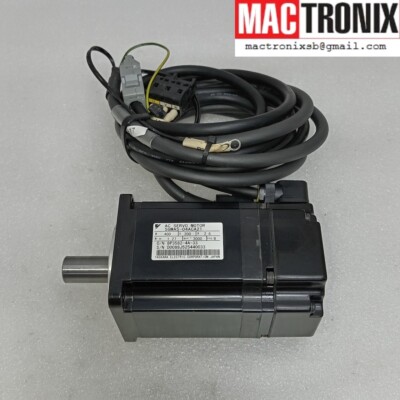
FWIW, I have found new 400W ac Yaskawa for about $US100 and used for a shade lower. Used drives for about $100. It appears that Yasakawa servos are very popular based on how many are available on eBay.

The tuning software is impressive. First it determines the moment of inertia. Rotates both directions 10 times or so. Then when tuning it warns you to make sure the motion will not be impeded and to make sure your body parts are not in harms way, and then it goes through a series of moves first slow and then eventually very very fast, changing directions rapidly, braking etc. It’s quite something to see. When all done it asks if you want to save the settings. The yes button should read “absolutely and thank you” because it just did in minutes what I spent hours trying to accomplish with my stepperonline servos and I have no doubt the software did a much much better job than I did manually.
 
Thanks JC.

That’s helpful.

FWIW, I have found new 400W ac Yaskawa for about $US100 and used for a shade lower. Used drives for about $100. It appears that Yasakawa servos are very popular based on how many are available on eBay.

The tuning software is impressive. First it determines the moment of inertia. Rotates both directions 10 times or so. Then when tuning it warns you to make sure the motion will not be impeded and to make sure your body parts are not in harms way, and then it goes through a series of moves first slow and then eventually very very fast, changing directions rapidly, braking etc. It’s quite something to see. When all done it asks if you want to save the settings. The yes button should read “absolutely and thank you” because it just did in minutes what I spent hours trying to accomplish with my stepperonline servos and I have no doubt the software did a much much better job than I did manually.
Bergerda does have PC software to set it up. I don't know if it does automatic tuning. Mine always worked pretty well right out of the box. I checked EBAY. Prices for Yaskawa appear to run higher than that for the motor and about $60 to $90 for the drives. I'd go for it if it tunes that easily. You'll love a servo way more than you ever would a stepper.
 
Thanks JC.

That’s helpful.

FWIW, I have found new 400W ac Yaskawa for about $US100 and used for a shade lower. Used drives for about $100. It appears that Yasakawa servos are very popular based on how many are available on eBay.

The tuning software is impressive. First it determines the moment of inertia. Rotates both directions 10 times or so. Then when tuning it warns you to make sure the motion will not be impeded and to make sure your body parts are not in harms way, and then it goes through a series of moves first slow and then eventually very very fast, changing directions rapidly, braking etc. It’s quite something to see. When all done it asks if you want to save the settings. The yes button should read “absolutely and thank you” because it just did in minutes what I spent hours trying to accomplish with my stepperonline servos and I have no doubt the software did a much much better job than I did manually.
Wow, self-tuning that impressive!
 
Bergerda does have PC software to set it up. I don't know if it does automatic tuning. Mine always worked pretty well right out of the box. I checked EBAY. Prices for Yaskawa appear to run higher than that for the motor and about $60 to $90 for the drives. I'd go for it if it tunes that easily. You'll love a servo way more than you ever would a stepper.

Ac servos on three of my machines now. I have had no steppers for a while now.


One example….


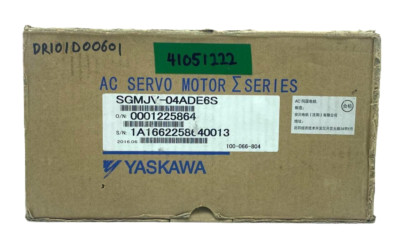
Or new, more than I paid for my last new one $(105), but not crazy expensive for new, considering free shipping.


Last edited:
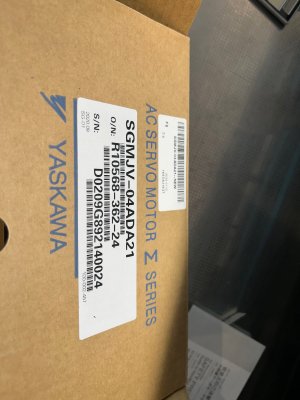
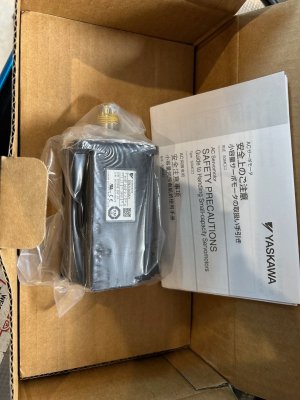
Z-axis is complete, now working on the X-axis, and look what just showed up..

Bonus, free shipping and no brokerage fee. I will give it a spin tomorrow if time permits.

Apparently the ballscrew is in Mississauga (cleared customs), so it should be here in a couple of days.


Getting closer.
IMG_0022.jpegIMG_0024.jpeg
 
What diameter and lead are your ballscrews?

Not a lot of space under there, so I’m going small (1605). To get it to fit I’m going to need to grind / mill the flange. I had an old 1605 shell and for a reality check, I ground down the flange and it now drops in. Will do the same for the new one when it arrives.
I can live with a little bit of error on the Z axis so I used 1um Ditron magnetic scales and they seem decent, but I want to avoid the cyclic error for the X axis, so I decided to use a higher accuracy glass scale for the cross slide. Both Sino and Akron offer pretty small glass scales that have shown to be quite accurate. I’m still waiting for that scale to arrive.
 
Last edited:
Not a lot of space under there, so I’m going small (1605). To get it to fit I’m going to need to grind / mill the flange. I had an old 1605 shell and for a reality check, I ground down the flange and it now drops in. Will do the same for the new one when it arrives.
I had to do the same thing on both sides of the nut when I installed the 1210 in my Milo mill.

1770593260609.jpeg
 
I can live with a little bit of error on the Z axis so I used 1um Ditron magnetic scales and they seem decent, but I want to avoid the cyclic error for the X axis, so I decided to use a higher accuracy glass scale for the cross slide.

A few years ago, I did a full battery of very rigorous tests against Lab grade gauge blocks to evaluate cyclic error and couldn't validate that it was real. At the time, Yuri thought I might have some unicorn scales. Since then Yuri got into selling scales and did a bunch more testing in the process including evaluating different scale manufacturers. As a result, he has backed away from his concerns about cyclic error but isn't quite ready to throw in the towel.

I personally don't think you need to be concerned about it, but everyone needs to satisfy themselves according to their own needs.
 
A few years ago, I did a full battery of very rigorous tests against Lab grade gauge blocks to evaluate cyclic error and couldn't validate that it was real. At the time, Yuri thought I might have some unicorn scales. Since then Yuri got into selling scales and did a bunch more testing in the process including evaluating different scale manufacturers. As a result, he has backed away from his concerns about cyclic error but isn't quite ready to throw in the towel.

I personally don't think you need to be concerned about it, but everyone needs to satisfy themselves according to their own needs.

The error graphs Ditron includes, combined with the what I see when I test was enough to convince me.

When turning for an interference fit for bearings I want to be in the tenths and I’m not sure I can trust most magnetic scales for that.

I have a collection of 6.5-7.5 digit multimeters. It’s easy to trust what you see, until you connect them all up to the same source and compare.

Segal’s law….

A man with a watch knows what time it is. A man with two watches is never sure.
 
I have a collection of 6.5-7.5 digit multimeters. It’s easy to trust what you see, until you connect them all up to the same source and compare.

You have touched one of my sore spots..... Better sit down with a glass of your favorite beverage.

I'm well aware of this issue. That's why I used lab grade gauge blocks for my testing. It's also part of why I'm not really a big fan of digital either.

I try to keep in mind that 1 micron is 0.00004 or half a tenth. I typically found errors up to 6 microns worst case using lab grade blocks - that's 3 tenths. But usually much better because that was only on the cycle peak. The average error was much less off peak.

The other thing I found but have not exploited is the repeatability. Cyclic error is by its nature very repeatable. Once it is known, it can be corrected for. I know that's not an ideal situation. It's much easier to just read a number and trust it. If only that were true. It might be worth doing such a calibration on mission critical work. I suppose one could even keep a chart beside the lathe. As long as one maintains a baseline set point, it wouldn't change overnight.

If you are really concerned about it, consider Renishaw High-End Tape. They claim it has typical errors that are half that of optical. And of course that assumes perfect optical - which it isn't. I have not actually tested optical myself but just examining the physics suggests it can be significantly better than magnetic if everything is top notch. For the price point, I do have to wonder how top notch it really is though.

The reality is that cutting a part for a bearing to tenths accuracy is very difficult to do with a dro of any kind on a lathe. That's partly because the error doubles on the diameter, but also because an absolute digital number is so misleading. I expect you understand this at a very fundamental level given your experience in the digital/analog world and your comments above. As much as I might like to trust a dro (no matter what technology) for tenths work. I can't, and I wouldn't. Factors like tool pressure on the part, spring in the tools, strain in the tool holder and tool post system, lathe alignment, temperature, and finish all conspire to lead me astray. These factors even apply to the very best tool room lathes. I prefer lathe work to mill work, but this is one area where a mill clobbers a lathe. Metal is metal and everything is rubber. So I measure using good reliable metrology on the exact dimension of the part I'm working on. Any dro, no matter how perfect, is going to give relative measurements inferred by those seen at the scale and read head which is not going to be the real dimension on the part for all the reasons stated above and many more.

I'm not trying to piss on your parade, I'm just relating my own experience and my expertise from my days of doing sensor development in the auto industry and of course my time standing beside my hobby level lathe.

Segal’s law….

A man with a watch knows what time it is. A man with two watches is never sure.

I've never heard this before! Sooooo true. I've complained about this before on this forum and elsewhere. It's sooooo easy to read a digital number and believe it. I don't. I don't think you do either.

For me, there are two knowns:

1. At the tenths level on an absolute (not relative) basis, I will still have to measure with either glass or magnetic. Either one will be fine with small magnitude incremental measurements.

2. I want my dro scale inside the cross-slide. Glass doesn't fit. Magnetic does.

For me, that means magnetic wins.

For absolute work in the tenths on a lathe, ya gotta measure no matter what kind of scale you have. Given the way cutting tool systems work on a lathe (especially inserts), the plain truth is that ya gotta measure for a few thou too. I've simply accepted that.
 
Thanks for that.

I did an experiment with a second 1um magnetic scale, I mounted it to my mill and then compared measurements between it and the installed scale. Most of the time the numbers are close to the same a tenth here a tenth there, sometimes a few tenths. Then I would test around the peaks to find the actual peak and the peak deviation was at times closer to 0.0015” Obviously a low peak on one and a high peak on the other.

For the minimal price difference I’m going to try and minimize that cyclic error for the X axis.

What I do now is get fairly close checking with micrometer and then zero the DRO, so even if there is cyclic error it’s going to be negligible over a really short span. That and not try and sneak up on the final value, those < 0.003” passes are a recipe for overshoot when the cutter finally bites.
 
Back
Top