

CWelkie
Super User
Awhile back I posted about the crispy wiring and loose connections found in my Grizzly G4003G lathe cabinet. I foolishly thought repairing/replacing the bad wiring and tightening everything up would due the trick long term.
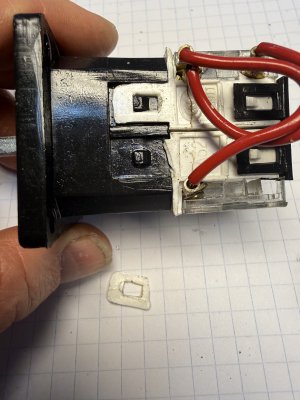
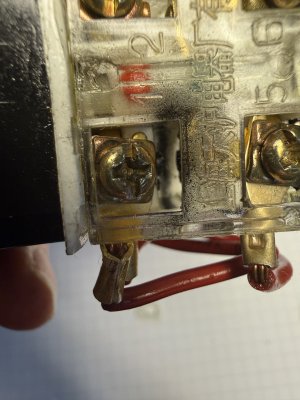
Within a couple days the lathe was back to "starting with a stutter" on the two highest speed selections. After a bit more searching I discovered that the forward/reverse switch had a couple broken tabs and a set of contacts that looked pretty rough. The clear plastic switch blocks weren't securely attached to the cam mechanism. The contacts were showing signs of arcing - the other contacts were nice and clean.
A functional equivalent was sourced and installed. (Yes, from Aliexpress.) "All good"; the chattering contactor noise was gone. Hoorah!
And then the motor wouldn't start every time. It would try to start but hum until the slightest assistance got it going. Bloody Heck!
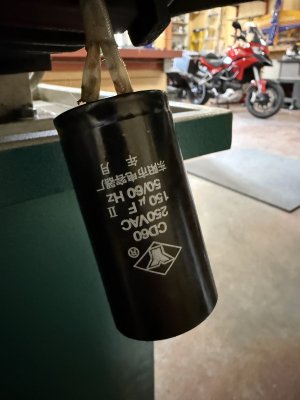
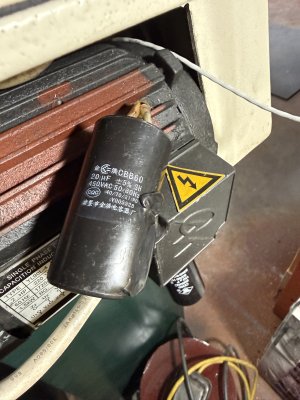
So, let's take a look at the capacitors on the motor. On this lathe the run capacitor is below the start capacitor. The lower capacitor cover had a "bunch" of oil in it but the upper capacitor looked fine. The upper capacitor - not so much.
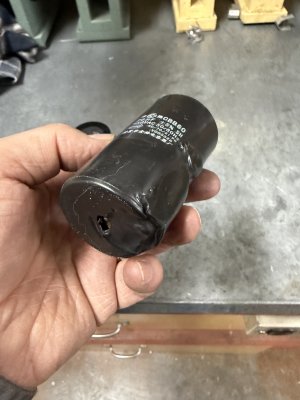
Trouble starting but the run capacitor is dead ... hmmm. Oh well, let's change them both for good measure.
If anything, the stall-on-startup became more frequent. Bloody Heck squared!
Nothing left for it but to pull the motor and open 'er up to check the centrifugal switch and contacts. I'm happy to report that the motor came apart nicely with no surprises. The mechanics of the switch were all good (no binding, all the springs were in place and the snap action worked fine). The contact showed evidence of arcing and some pitting so I unsoldered the wiring for a good clean up with a points file (remember those?).
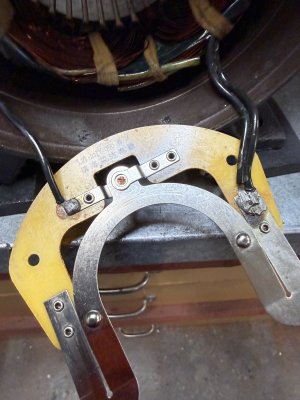
Time to put it all back together. (Did I ever mention how glad I was that the lathe isn't right up against the wall?).
Son-of-a-gun if it didn't start and run as smooth as new. It's been a couple days now with many, many start/stop cycles at the highest speed. (Whole bunch of small diameter shafts to face each end, trim to specific length and centre drill.) She hasn't missed a beat!
It's been quite a trip but am so glad I could sort it out. Maybe the model steam engine I'm working on will get built after all ...
Within a couple days the lathe was back to "starting with a stutter" on the two highest speed selections. After a bit more searching I discovered that the forward/reverse switch had a couple broken tabs and a set of contacts that looked pretty rough. The clear plastic switch blocks weren't securely attached to the cam mechanism. The contacts were showing signs of arcing - the other contacts were nice and clean.
A functional equivalent was sourced and installed. (Yes, from Aliexpress.) "All good"; the chattering contactor noise was gone. Hoorah!
And then the motor wouldn't start every time. It would try to start but hum until the slightest assistance got it going. Bloody Heck!
So, let's take a look at the capacitors on the motor. On this lathe the run capacitor is below the start capacitor. The lower capacitor cover had a "bunch" of oil in it but the upper capacitor looked fine. The upper capacitor - not so much.
Trouble starting but the run capacitor is dead ... hmmm. Oh well, let's change them both for good measure.
If anything, the stall-on-startup became more frequent. Bloody Heck squared!
Nothing left for it but to pull the motor and open 'er up to check the centrifugal switch and contacts. I'm happy to report that the motor came apart nicely with no surprises. The mechanics of the switch were all good (no binding, all the springs were in place and the snap action worked fine). The contact showed evidence of arcing and some pitting so I unsoldered the wiring for a good clean up with a points file (remember those?).
Time to put it all back together. (Did I ever mention how glad I was that the lathe isn't right up against the wall?).
Son-of-a-gun if it didn't start and run as smooth as new. It's been a couple days now with many, many start/stop cycles at the highest speed. (Whole bunch of small diameter shafts to face each end, trim to specific length and centre drill.) She hasn't missed a beat!
It's been quite a trip but am so glad I could sort it out. Maybe the model steam engine I'm working on will get built after all ...
